MAKE BETTER PROCUREMENT DECISIONS
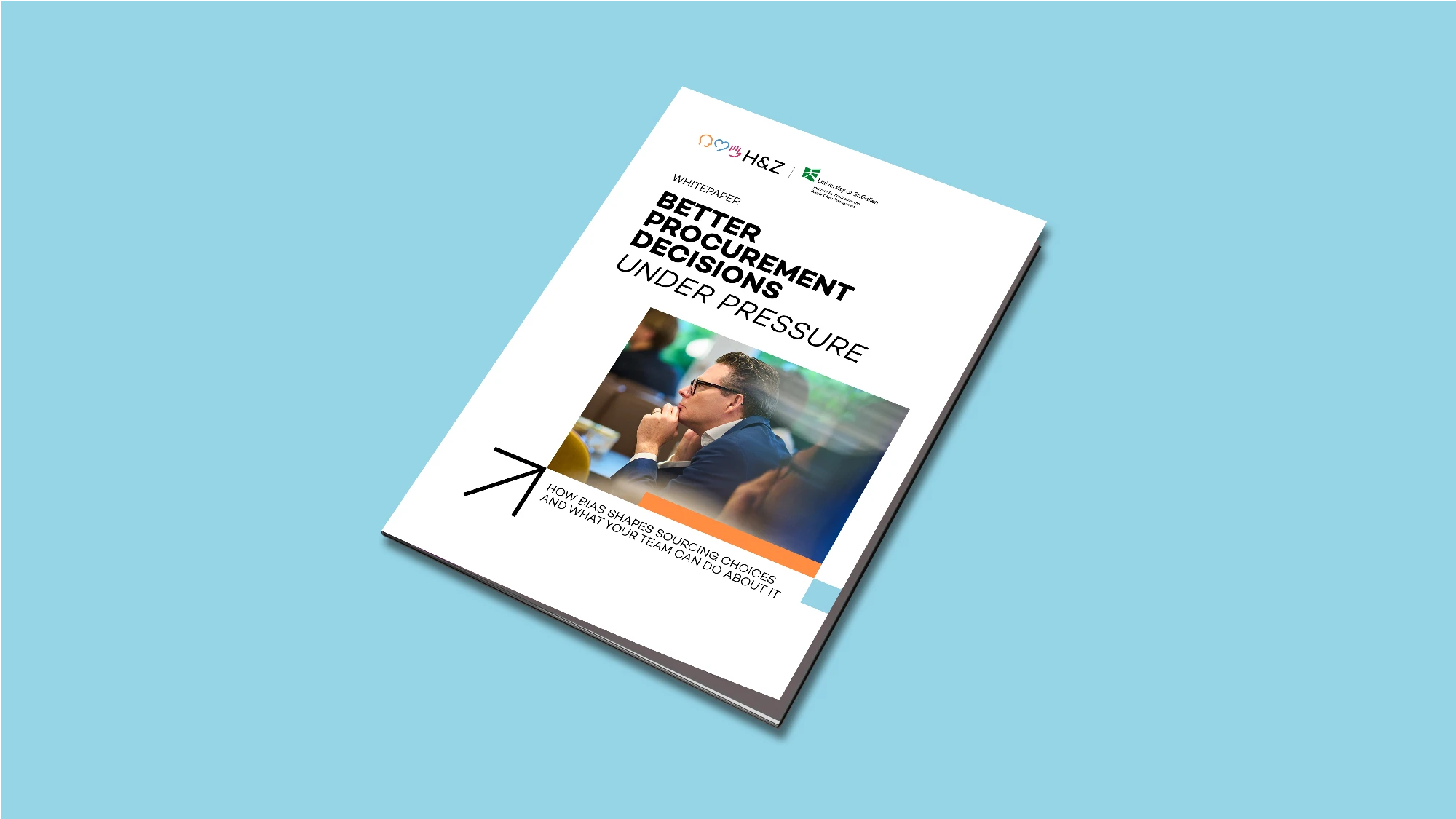
Geopolitical uncertainty and supply disruption put procurement judgement to the test. Our new whitepaper examines what shapes sourcing choices and proposes changes for CPOs.
WHAT COULD SWAY YOUR NEXT SOURCING DECISION?
- AI recommendations influenced judgement. Survey respondents shown a higher AI suggestion recommended giving more business to the secondary supplier, despite identical sourcing options.
- Keeping an incumbent carried accountability. After delivery problems, 52% held management very or completely accountable for retaining the supplier, compared with 39% for switching.
- Immediate savings did not dominate. In one scenario, 87% preferred the supplier offering longer-term quality and resilience advantages over a larger first-year saving.
The whitepaper examines these findings and proposes six practical changes to help CPOs challenge assumptions and give strategic priorities proper weight in sourcing decisions.
By Dr. Philipp Rolf and Martina Buchhauser (H&Z), M.Sc. Anna-Kristin Behnert and Prof. Dr. Julia Arlinghaus (University of St.Gallen). Based on our Procurement Pulse Check survey of 118 procurement professionals.
HOW PROCUREMENT PROFESSIONALS DECIDE
Through timed sourcing scenarios, participants assessed supplier choices, competing priorities, and managerial accountability. We tested four cognitive biases: anchoring, herding, omission, and short-term bias.
What’s Inside?
- How AI-generated starting values influence supplier allocation recommendations
- How industry benchmarks affect assessments of competing suppliers
- How accountability differs between switching suppliers and retaining an incumbent
- How immediate savings compare with longer-term supplier advantages
- Six proposed changes to sourcing governance
- A framework for reviewing how decisions are prepared, challenged, approved, and revisited
PUT YOUR SOURCING PROCESS TO THE TEST
Does your team form an independent view before seeing recommendations? Does retaining an incumbent face the same scrutiny as switching? The paper’s proposed changes and framework help you review how sourcing decisions are prepared, challenged, approved, and revisited.
Explore our procurement consulting.
DOWNLOAD OUR WHITEPAPER
Explore the scenarios, findings, and implications for procurement judgement.
CONTACT OUR EXPERTS


YOUR QUESTIONS ANSWERED
How can procurement teams reduce bias in sourcing decisions?
By changing the process, not by appealing to awareness. The paper’s five-area framework asks teams to challenge the anchor, question the consensus, challenge the status quo, assess long-term value, and build in constructive challenge. Major sourcing decisions should be revisited after 6 to 12 months to compare the outcome with the assumptions made.
What is risk-adjusted total cost of ownership?
A comparison basis that replaces purchase price. Alongside the price, it includes disruption exposure, supplier concentration, quality, working capital, transition cost, and optionality, so that a resilient supplier is not penalised for a slightly higher quote.
Does AI make procurement decisions more objective?
Not automatically. In the survey, the value an AI-supported system had prefilled moved recommendations by six percentage points. Teams should review the rationale and the underlying data instead of accepting the output, and form their own view before the recommendation is shown.
Who conducted the study?
H&Z and the Institute for Production and Supply Chain Management at the University of St.Gallen, with 118 procurement professionals. The whitepaper was published in October 2026 and is free to download.