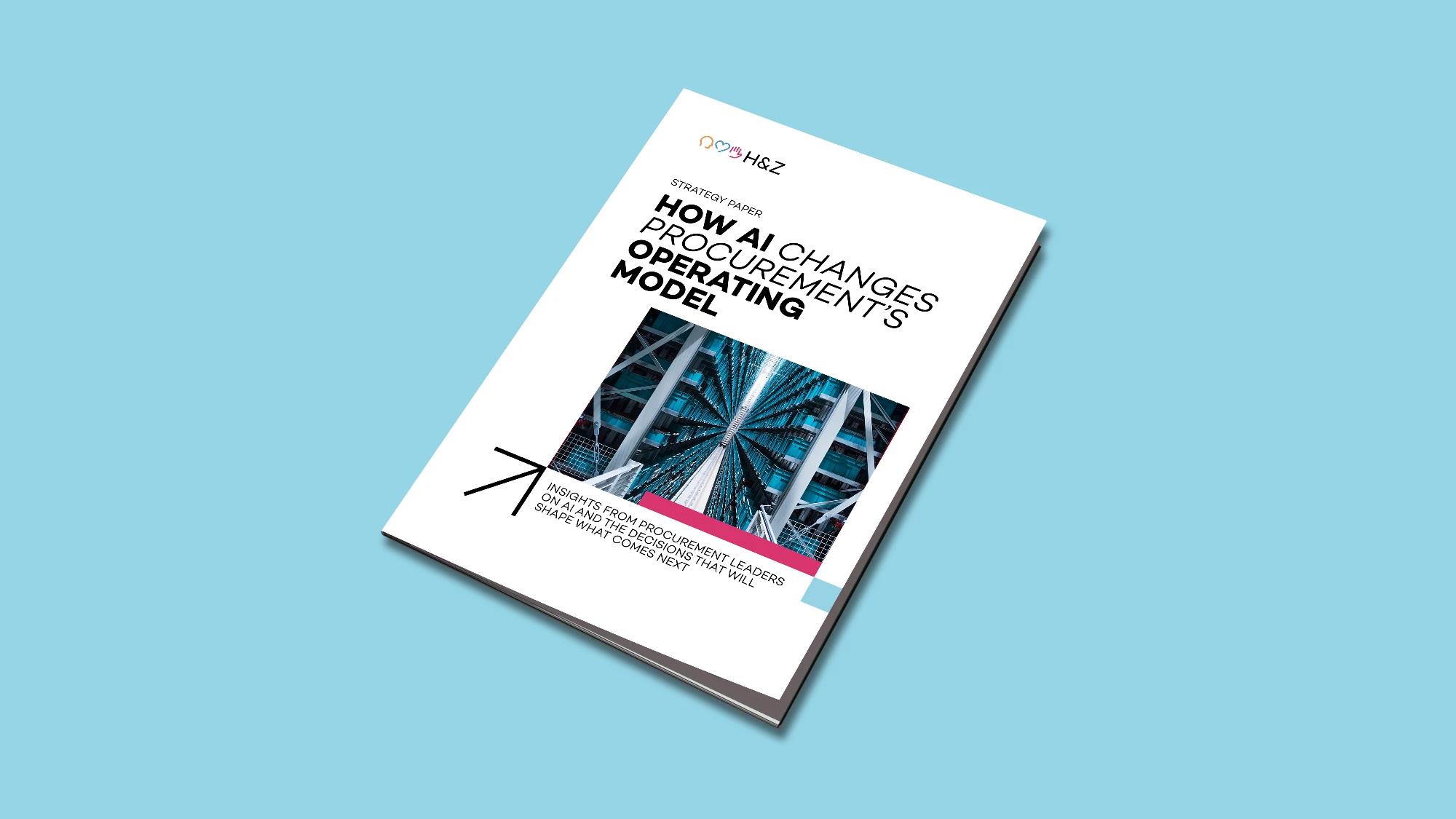
HOW AI CHANGES PROCUREMENT’S OPERATING MODEL
Insights from procurement leaders on AI and the decisions shaping what comes next. Where to start with automation, how roles could change and what CPOs must decide before scaling.
AI PUTS THE OPERATING MODEL ON THE CPO’S AGENDA
We conducted ten structured interviews with procurement leaders across the industrial, chemicals, logistics, financial services, and technology sectors. One tension stood out. Expectations for automation are growing faster than agreement on how to organise procurement teams to support it.
The paper examines where improvements to existing practices may be sufficient, where broader redesign may be needed, and what prevents promising applications from becoming established ways of working.
By Jonas Harm and Dominik Steffani
THE STUDY AT A GLANCE
FIVE FINDINGS ON AI AND THE PROCUREMENT OPERATING MODEL
-
01
The mandate stays. Its delivery changes materially.
Interviewees rated the impact on strategy and objectives and on culture and leadership as relatively low. By contrast, impact on IT systems and data and on processes and methods is expected to be substantial. AI agents need named owners who test their outputs and supervise their work.
-
02
Decide what to stop before you automate.
Processes should be reviewed end to end, applying lean principles before deciding what to automate.
-
03
Scaling fails on prerequisites, not on use cases.
Data quality and change management emerged as more pressing barriers than IT implementation capacity. Each priority use case needs a plan for resolving the barriers to wider adoption.
-
04
Two paths: selective augmentation or structural redesign.
The evolutionary path applies AI mainly as a tool to gain efficiency. The revolutionary path puts enhanced value creation at the forefront of the AI transformation.
-
05
Exploration still requires decisions.
The interviews revealed no common approach to scaling AI. CPOs should make their current priorities explicit, even while testing the options.
FROM PYRAMID TO DIAMOND
As agents take on transactional activities, procurement must decide how to use the capacity released. H&Z’s illustrative move from a pyramid to a diamond reflects a smaller transactional workforce and greater emphasis on strategic and specialist roles.
Illustrative. Shapes show the changing balance of human roles and are not drawn to a numerical scale. Fewer human roles do not imply an equivalent reduction in total operating costs.
What’s Inside?
- Five findings from interviews with procurement leaders
- Expected change across six dimensions of the procurement operating model
- The barriers that stop AI from scaling in procurement
- Two development paths: selective augmentation or structural redesign
- From pyramid to diamond: how procurement roles change as AI agents take on transactional work
- Three decisions for CPOs and how to put AI to work in procurement
THREE DECISIONS FOR CPOS
The interviews revealed no common approach to scaling AI. Our view is that CPOs should make their current priorities explicit, even while testing the options. Three decisions deserve attention:
-
01
What is your main purpose for AI: efficiency gains or increased value creation?
-
02
Do you start with a fundamental rethinking of end-to-end processes or make targeted process improvements to gain traction and experience?
-
03
Do you rely on IT and suite providers to deliver AI features within a reasonable timeframe, or give your procurement team scope to use or develop best-of-breed AI solutions with its own experts?
DOWNLOAD THE STRATEGY PAPER HERE
AI adoption puts decisions about procurement’s operating model on the CPO’s agenda. Technology choices alone cannot settle them. Download the full paper for all five findings, the two development paths and the three decisions CPOs should make explicit.
CONTACT OUR EXPERTS
Jonas Harm


YOUR QUESTIONS ANSWERED
What is a procurement operating model?
H&Z’s procurement target operating model framework covers six dimensions: strategy and objectives, organisation and governance, processes and methods, IT systems and data, people and roles, and culture and leadership. The study uses four stages to describe the expected degree of change from AI: Retain, Optimise, Redesign and Reinvent.
Who oversees AI agents in procurement?
AI agents need named owners who test their outputs and supervise their work. Standard cases can become candidates for automation, with people handling exceptions and overseeing the agents involved. CPOs must build these duties into procurement roles and equip people to fulfil them.
How will procurement roles change?
H&Z’s illustrative move from a pyramid to a diamond reflects a smaller transactional workforce and greater emphasis on strategic and specialist roles. AI agents take on purchase orders, requests for quotation, expediting and tail spend. This creates scope for more attention to category strategy, negotiation, supplier coverage and risk.
Does AI reduce procurement operating costs?
Fewer staff does not guarantee a proportionate reduction in operating costs. Decisions about released capacity must account for the cost of running and overseeing AI agents, including usage charges. The business case should specify the additional value procurement intends to deliver and how it will be measured.