HOW TO MONITOR AND EVALUATE SMART CITY DEVELOPMENTS
Practical approaches and recommendations on measuring impact for city administrations on the path to building resilient and sustainable cities.
The urban transformation of cities in Germany is steadily progressing. At the heart of this lies the concept of smart cities: cities that are not only digitally adept, but above all strategically enhance their resilience and sustainability. In order to effectively steer this complex development, reliable and systematic monitoring is required. But have German smart cities already embedded systematic measurement of progress and success within their strategic frameworks? We took a closer look at the status quo in this practice dossier and developed practical guidelines for cities who would like to set up a systematic monitoring of their smart city activities.
THE SMART CITY RANKING FORMS THE DATA BASIS
The result: amongst the top 50 smart cities in Germany, 22 currently have a well-founded monitoring and evaluation framework. Such a concept forms the basis for the targeted and systematic management of smart city activities. The basis for the analysis is provided by our Haselhorst Smart City Ranking, which we have been compiling annually since 2018 and which assesses Germany’s largest cities with a population of 30,000 or more based on their digital and sustainable development. Based on the results of the 2024 Smart City Ranking, we have drawn a sample and analysed the top 50 smart cities with regard to monitoring and evaluation.
In addition to the 22 local authorities mentioned, 15 further cities currently either have initial approaches in place for measuring the progress of smart city measures, or such approaches are at least already in the planning stage. In contrast, 13 smart cities do not yet have any concepts or approaches for evaluation.
QUALITATIVE INTERVIEWS UNDERPIN THE RESULTS
The quantitative analysis was supplemented by interviews with representatives from selected cities of varying sizes, including both smart cities funded by the federal government and those that are not. “In conversations with local governments, it becomes clear that existing approaches have so far focused primarily on the project and measure levels. There is an awareness and willingness to apply monitoring at the objective and strategic levels as well, but this often becomes very complex, is difficult to quantify, and is further complicated by the necessary collaboration between numerous specialist departments and project stakeholders,” explains Leonie Schiermeyer.
To address this, we present various best practices and tried-and-tested methods for measuring progress and success, including models for defining objectives and developing KPIs. In addition, we have developed a set of guidelines to provide local governments with guidance on the successful implementation of monitoring structures.
“Strategic monitoring first and foremost serves to optimise smart city projects and improve their efficiency. However, a well-thought-out system for measuring progress and success is also essential for communicating achievements and justifying measures to politicians, the administration, and the public,” emphasises Leonie Schiermeyer.
What's Inside
- The role of funding programmes and impact assessment
- The current state of progress monitoring in German smart cities
- Methodological approaches to monitoring and evaluation
- Best practices from other cities
- Challenges and needs from a local government perspective
- Guidelines for designing monitoring and evaluation processes
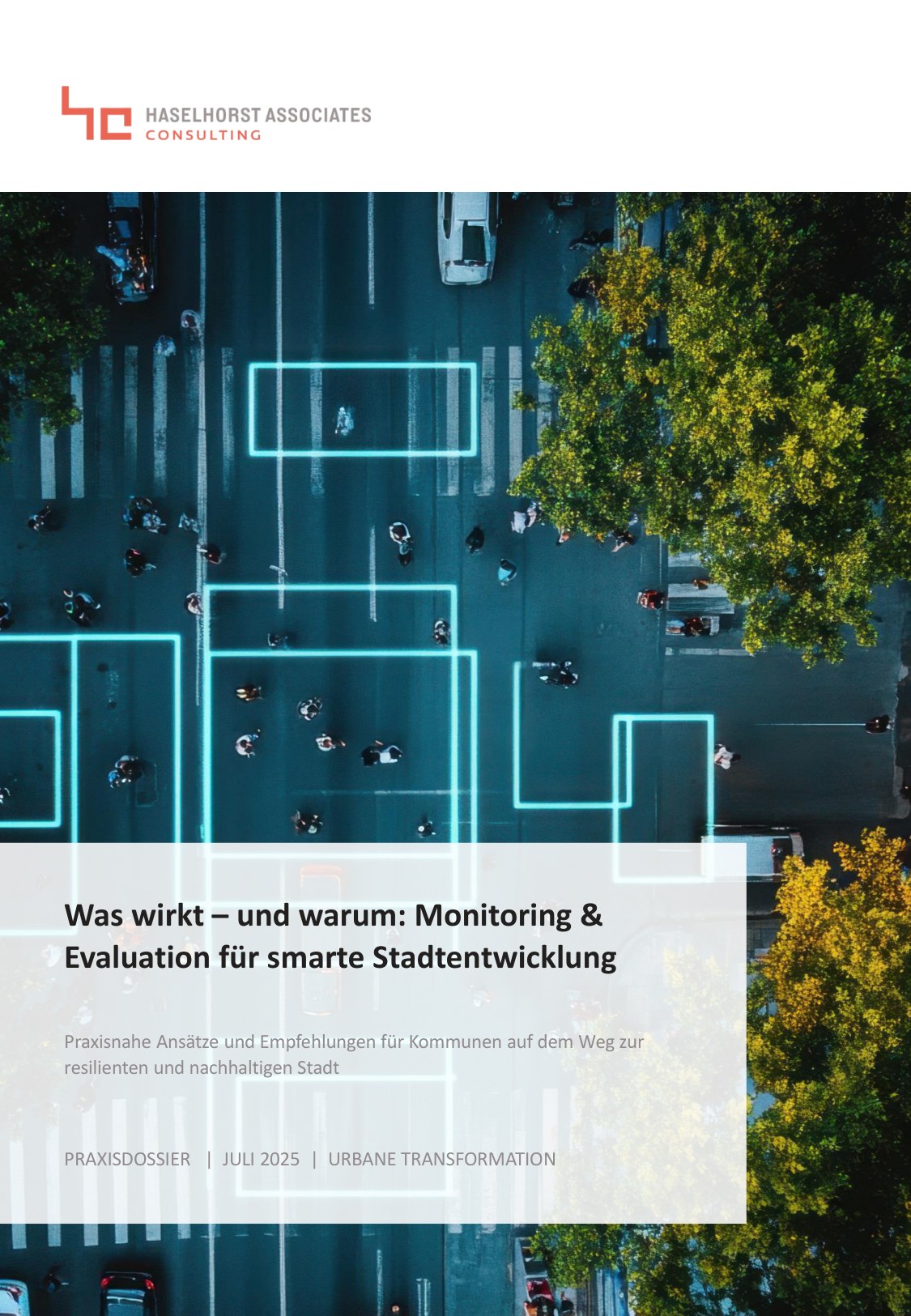
READ THE PRACTICAL GUIDE NOW
Smart city initiatives can only be managed effectively with clear objectives, measurable indicators, and a structured approach to monitoring progress. Make use of our practical guidelines to get started with systematic monitoring (only available in German).
CONTACT OUR EXPERT
Dr. Lucia Wright