Understanding the AI Maturity Model
An AI maturity model scores how deeply AI is embedded across eight capabilities. See the framework, the five levels, and where 75 organisations actually stand.
An AI maturity model measures how deeply AI is actually embedded in how an organisation works, not how much has been spent on it. That distinction matters more than it sounds: budget and maturity move together for the first year of an AI programme and then quietly diverge, and most of the frameworks published on this topic do not tell you where the gap actually opens up.
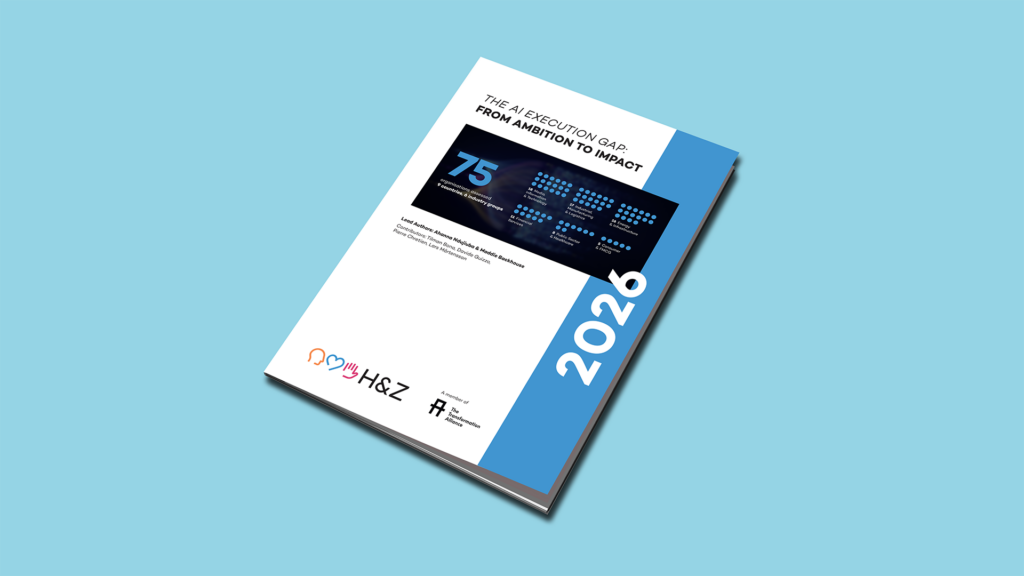
This article sets out what an AI maturity model is, the capabilities it should cover, and the five levels organisations typically move through. It also shows where 75 real organisations across nine countries actually landed when we measured it, rather than where AI maturity models assume they should be.
UNDERSTANDING AI MATURITY
An AI maturity model is a structured framework for assessing how consistently and effectively an organisation uses AI across a defined set of capabilities, from strategic direction through to governance and execution. It scores where an organisation currently stands, not where its AI strategy document says it wants to be.
The distinction is deliberate. Investment is easy to measure and easy to announce. Maturity is harder, because it asks whether the investment has actually changed how decisions get made, how processes run, and how people work, not just what tools sit on a licence list.
THE EIGHT CAPABILITIES
Our model groups AI maturity into eight capabilities across four dimensions. Direction and Foundations establish intent and provide the data and technology to act on it; Execution and Control determine whether that intent actually reaches daily work.
1. Strategy & Leadership
Clarity of AI ambition, executive sponsorship, and the link between AI and business priorities.
2. AI Initiatives & Business Impact
How effectively use cases are identified, prioritised, scaled, and measured for tangible value.
3. Data Management & Infrastructure
Quality, accessibility, and ownership of data, plus the platforms that support AI reliably.
4. Tools & Technology
Maturity of the AI tooling ecosystem: platforms, integration, scalability, and vendor approach.
5. People & Skills
Workforce capability to use AI effectively, from leadership literacy to role-based enablement.
6. Operating Model & Processes
How AI is structured, prioritised, and embedded in operations, from idea to deployment.
7. Change Management
The ability to drive adoption, reshape behaviours, and embed AI into day-to-day ways of working.
8. Governance & Ethics
Policies, controls, accountability, and risk management that let AI scale responsibly.
In our study, all eight scored within a narrow band of 2.4 to 2.7 out of 5. That narrow spread is itself a finding: organisations are not failing at one capability while excelling at the others. Their maturity is generally low across the board, with two capabilities pulling the average down further than the rest.
The five maturity levels
Within each capability, organisations typically sit at one of five levels, from isolated individual initiative through to a fully embedded, continuously measured operating rhythm.
Ad Hoc
Isolated experiments, no articulated vision, benefits assumed rather than measured.
Localised
Pilots deliver local wins, but ownership, standards, and measurement stay inconsistent.
Integrated
Board-approved roadmap, shared standards, and repeatable delivery across business areas.
Scaled
AI is a core strategic lever with enterprise platforms, value dashboards, and embedded change.
Optimised
AI shapes strategy and market positioning, with continuous optimisation loops across workflows.
Where the market stands: with a cross-pillar average of 2.62, most organisations sit between Localised and Integrated. The pink markers show where two-thirds of organisations scored in Change Management: Level 2 or below.
Most organisations we studied sit between Localised and Integrated on the capabilities that scored around 2.5, and closer to Integrated on the ones that scored 2.7. Very few had reached Scaled on any capability, and Optimised was rare across the whole set.
Where organisations actually stand
Across 75 organisations in nine countries, surveyed between July 2025 and February 2026, the average AI maturity score was 2.62 out of 5. Four capabilities tied at 2.7: Strategy & Leadership, Data Management & Infrastructure, People & Skills, and Governance & Ethics. The two weakest were Change Management at 2.4 and Operating Model & Processes at 2.5, with roughly two-thirds of organisations sitting in the bottom two maturity levels on Change Management specifically.
That pattern is the actual headline of the study, and it is easy to miss if you only look at the average. Organisations are not short of strategy, data, or governance intent. What is missing is the operating discipline and the people-side adoption that turn intent into consistent practice. Direction and Foundations are ahead of Execution and Control, which is the opposite of where most AI vendor content focuses.
How to run an assessment
A maturity assessment is only useful if it changes what the organisation does next, so the process matters as much as the scoring model.
- Assess capability by capability, not as a single AI score. A single number hides exactly the kind of unevenness this study found.
- Involve the people who run the process, not only the team that built the AI use case. Change Management scores badly precisely because assessments often skip this group.
- Repeat it on a fixed cycle, not once. A maturity model measured once is a snapshot; measured twice a year, it becomes a management tool.
- Tie the result to a decision. An assessment that does not change budget, priority, or governance was not worth running.
If you want a quick starting point rather than building an internal process from scratch, the free AI maturity self-assessment benchmarks your organisation against the same eight capabilities and the same 75 organisations covered in this study.
How H&Z can support you
Running an internal AI maturity assessment is straightforward to start and easy to get wrong in the scoring: teams tend to overrate the capabilities they own and underrate the ones they do not see day to day. Our Digital & AI team supports organisations through structured, benchmarked assessments across all eight capabilities, and through turning the result into a prioritised roadmap rather than a report that sits in a folder.
FREQUENTLY ASKED QUESTIONS
What is AI maturity?
AI maturity is how consistently and effectively an organisation uses AI across eight defined capabilities, spanning strategic direction, data and technology foundations, day-to-day execution, and governance. It reflects how embedded AI is in daily practice, not how much has been invested in it.
What are the levels of AI maturity?
Most maturity models, including ours, use five levels: Ad Hoc, where AI use is individual and unstructured; Localised, where it works in pockets; Integrated, where it runs on defined processes; Scaled, where it operates consistently across the business; and Optimised, where performance is actively measured and refined.
How do you assess AI maturity?
By scoring each capability separately against defined criteria, ideally involving both the teams building AI use cases and the teams expected to adopt them, then repeating the assessment on a regular cycle so progress, or the lack of it, becomes visible.
What is a good AI maturity score?
There is no universal benchmark, but our study of 75 organisations found an average of 2.62 out of 5 across eight capabilities. A score meaningfully above that average, particularly on Operating Model and Change Management, indicates a genuine lead over typical peers rather than a strong pilot programme.
What is the difference between AI readiness and AI maturity?
AI readiness typically asks whether the foundations (data, skills, infrastructure) are in place to start using AI. AI maturity asks how far an organisation has actually progressed in using it consistently and effectively once those foundations exist. Readiness is a starting-line question; maturity is a progress question.
RELATED READING
The two capabilities holding this average down have their own deep dive: our AI operating model article covers why Operating Model and Change Management lag behind the rest. AI governance, one of the four capabilities scoring 2.7, is covered separately. All three are drawn from our full study, The AI Execution Gap, conducted with The Transformation Alliance.