HOW CAN YOUR CITY BECOME A CLIMATE SMART CITY?
How German cities are using data-driven approaches to build resilience against crises.
Cities in Germany are facing a wide range of crises. These include, amongst others, extreme weather events resulting from the climate crisis, power cuts, gas or energy crises, and cyber-attacks. One concept that responds holistically to all these challenges and provides solutions is that of the ‘Climate Smart City’.
“A Climate Smart City integrates advanced technologies and relies on interdisciplinary collaboration to tackle climate crises and promote sustainable, resilient, and thus future-proof urban development,” explains Dr Lucía Wright of Haselhorst Associates. Together with the LOEWE Centre emergenCITY at the University of Kassel, the University of Marburg, and the Technical University of Darmstadt, the consulting firm has examined, as part of a practice dossier, the extent to which data-driven crisis management is already widespread in German cities as part of a Climate Smart City, and what recommendations for action can be derived from this for local authorities.
The selection of cities is based on the Haselhorst Smart City Ranking, which annually assesses the digital and sustainable development of more than 400 of Germany’s largest cities. In total, 43 cities were examined and 90 initiatives identified that use data and technology in crisis management and civil protection. 24 of these cities (56 per cent) have explicitly integrated data-driven crisis management into their smart city or digitalisation strategies, 14 (32 per cent) show individual initiatives, and five (12 per cent) have none at all. The initiatives most frequently address floods (25), heavy rainfall (21), and heat (17).
CREATING A HOLISTIC FRAMEWORK FOR HANDLING DATA
Data-driven crisis management holds great potential for the transition towards Climate Smart Cities. “Embedding these initiatives in the form of strategic approaches promotes the systematic and sustainable integration of crisis management and disaster risk reduction into urban planning,” explains Lucía Wright, adding: “To ensure that integrated and interconnected solutions emerge, such projects should not be developed and implemented in isolation, but rather viewed as part of a coordinated, holistic approach. Crisis management is a complex field that must be addressed strategically, sustainably, and in an interdisciplinary manner.”
Among other things, the development of a holistic data strategy is necessary for the long-term success of data-driven crisis management. This serves as a guide for the use of urban data by defining a set of rules for data collection, processing, maintenance, and analysis. “Such a data strategy serves as a holistic framework that establishes technical, ethical, legal, and quality standards to enable the responsible and effective use of urban data,” says Lucía Wright.
What's Inside
- Socio-spatial dimensions of crises and vulnerabilities, and their impact on crisis communication
- The relevance of urban data in crisis management
- Concept and characteristics of a Climate Smart City
- Insights into data-driven crisis management in German cities
- Crisis management initiatives and innovative approaches to strengthening crisis communication
- Key factors for designing resilient cities, with recommendations for municipal stakeholders
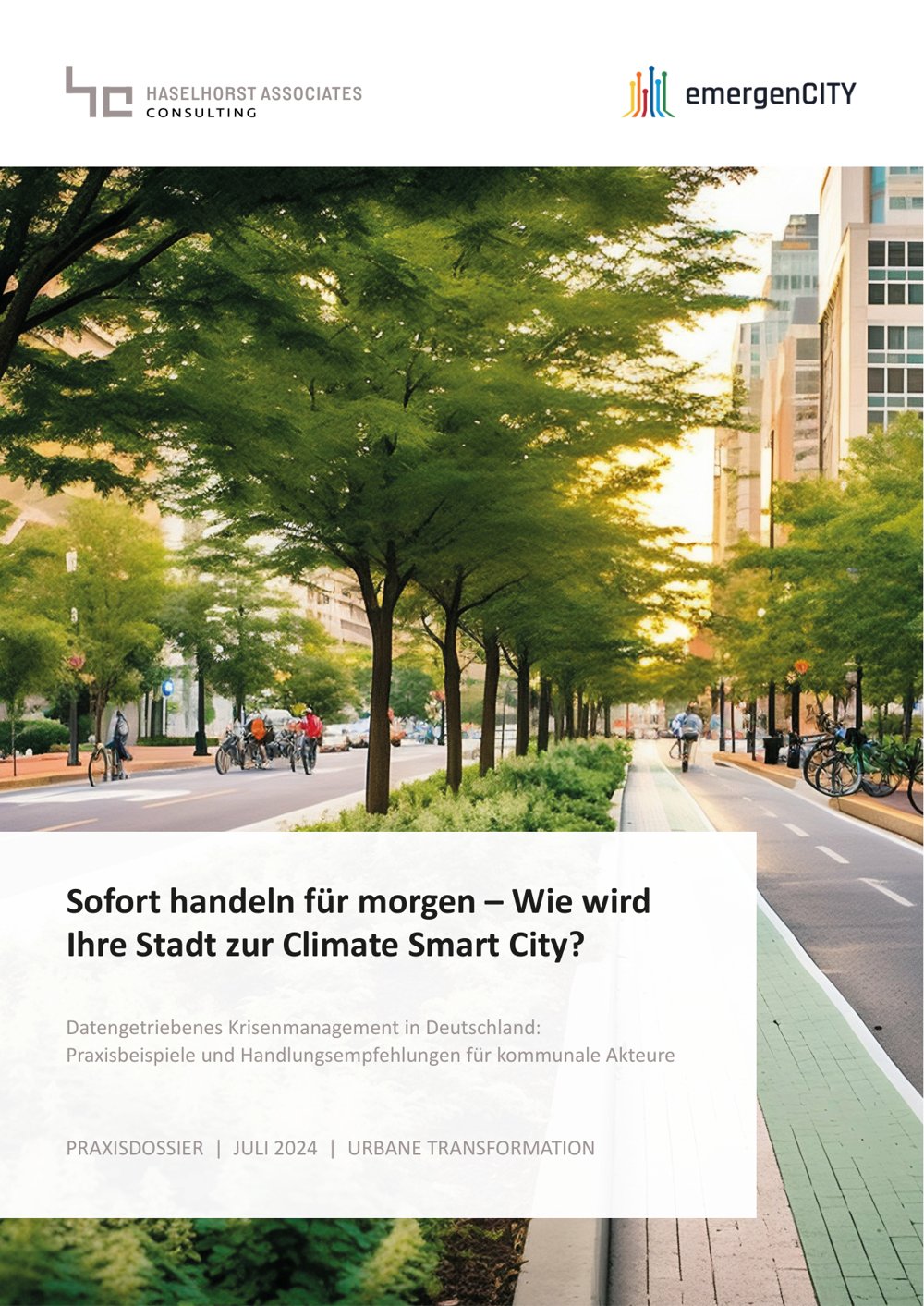
READ THE PRACTICAL GUIDE NOW
Take action for the future now. Benefit from the practical examples and recommendations as you work towards becoming a Climate Smart City (only available in German).
CONTACT OUR EXPERT
Dr. Lucia Wright