A Practical AI Governance Framework
An AI governance framework defines accountability, decision paths, and risk classes. What it must cover, who owns it, and how far 75 organisations have actually got.
An AI governance framework defines who is accountable for AI decisions, which risks get escalated, and how much autonomy a model or a team is allowed to have. Without one, organisations tend to discover their AI risk appetite by accident, usually after something has already gone wrong.
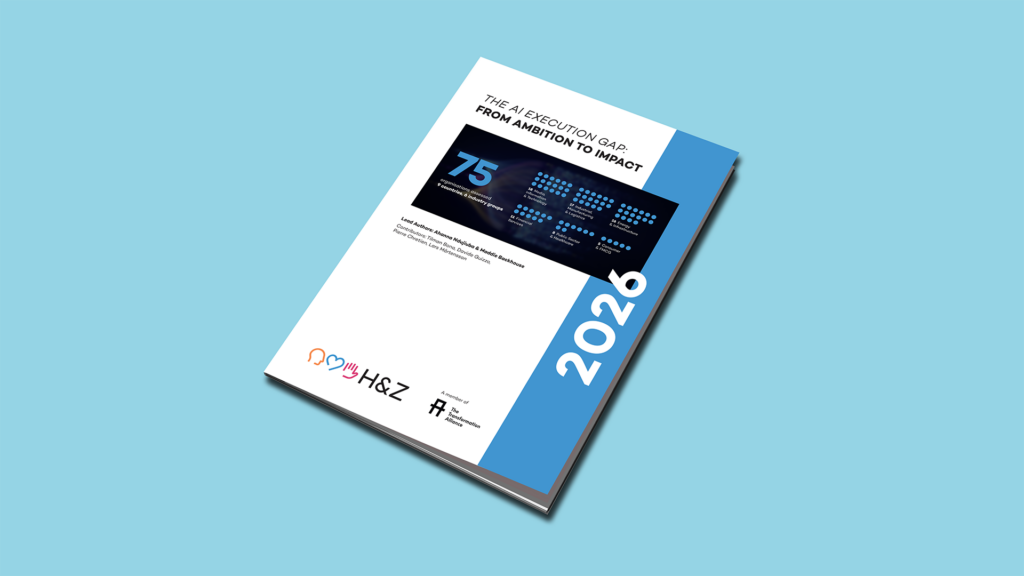
That is the gap this article addresses. Search interest in AI governance is high, but most of what ranks for it comes from technology vendors describing a product feature, not from an organisational answer to who owns what. This piece treats AI governance as a question of leadership and organisational structure, based on what 75 organisations across nine countries actually reported about how they run it.
UNDERSTANDING AI GOVERNANCE
An AI governance framework is the set of policies, roles, and decision rights that determine how an organisation develops, deploys, and monitors AI systems. It covers accountability, risk classification, and the escalation paths that decide when a human, not a model, makes the final call.
Governance is not the same as compliance, and it is not the same as ethics on its own. Compliance asks whether a system meets external rules. Ethics asks whether it should exist at all. Governance sits between the two: it is the operational machinery that turns principles and regulation into decisions people can actually make on a Tuesday afternoon.
WHAT A GOVERNANCE FRAMEWORK HAS TO COVER
A governance framework that only exists as a document rarely survives contact with a live AI project. To hold up in practice, it needs to cover four areas, and the risk-classification piece is the one organisations get wrong most often. More on that below.
Accountability
A named owner for every AI use case, not a committee that meets quarterly.
Decision paths
A clear route from “we want to try this” to “we are allowed to ship this.”
Risk classes
Oversight that matches the actual risk, not the loudest use case.
Transparency
Documentation that explains a decision after the fact.
A worked example: two risk classes
Take two use cases sitting in the same organisation. A marketing team wants an AI assistant to draft first versions of social copy, which a human always reviews before anything is published. A lending team wants to use a model to help score credit applications, feeding directly into an approval decision.
Under a working governance framework, these do not go through the same process:
- The copy assistant needs a named owner, a basic acceptable-use policy, and a light review, because the downside of a bad output is a rewritten paragraph.
- The credit model needs a documented risk assessment, bias testing, an explicit human-in-the-loop checkpoint, and regular monitoring, because the downside of a bad output is a wrongly declined or approved loan.
Treating both cases identically either buries the copy assistant in unnecessary process or, more dangerously, lets the credit model through on the same light-touch review. Risk classification is what prevents both failure modes at once.
Who owns it
Ownership is the part organisations get wrong most often. A governance framework without a clear owner tends to default to whichever team built the loudest AI pilot, which is rarely the right answer for enterprise-wide risk.
“We quickly established an AI governance board with clear accountability under the Company Secretary. This has enabled a structured and well-governed approach to AI adoption.”
Chief Strategy Officer, UK media organisation
The pattern worth copying here is not the specific reporting line. It is the speed: the board came first, before the wave of individual pilots that usually forces governance into existence reactively.
Governance without friction
The point of a governance framework is to create trust, not to slow everything down. A framework that adds three approval layers to a low-risk experiment will get bypassed, quietly, by whoever is under delivery pressure that week. A framework that gives teams a fast, clear path for low-risk work and a rigorous one for high-risk work gets used.
This is the trade-off that separates governance frameworks that work from ones that exist only on paper: proportional friction, not maximum friction.
Where organisations stand
In our study of 75 organisations across nine countries, Governance & Ethics scored 2.7 out of 5, one of the strongest of the eight capabilities we measured. That is a reasonable starting position. Most organisations have written something down.
The weakness sits elsewhere. Change Management scored 2.4 and Operating Model & Processes scored 2.5, the two lowest of the eight. In other words, the rules tend to exist. What is missing is the operating muscle to apply them consistently once AI moves from a pilot into daily use across the business. A governance framework is a necessary condition for responsible AI adoption, not a sufficient one.
How H&Z can support you
Writing a governance framework is a few weeks of work. Making it survive contact with fifty live use cases across different business units is the harder part, and it is where most organisations ask for outside help: structuring accountability, setting risk classes that actually match the organisation’s risk appetite, and building the operating model that keeps the framework alive after the first steering committee meeting. Our Digital & AI team works with leadership teams on exactly this, from the initial governance design through to embedding it in how AI decisions actually get made.
FREQUENTLY ASKED QUESTIONS
What is an AI governance framework?
An AI governance framework is the set of policies, roles, and decision rights an organisation uses to develop, deploy, and monitor AI systems responsibly. It defines who is accountable, how risk is classified, and when a decision has to be escalated to a human.
What should an AI governance framework include?
At minimum, it should cover accountability for each AI use case, a clear decision path from idea to deployment, defined risk classes so oversight matches actual risk, and enough transparency that decisions can be explained after the fact.
Who is responsible for AI governance?
Responsibility should sit with a named owner or board with real authority, not a rotating committee. In practice this is often a governance board reporting to a senior leadership function, supported by risk, legal, and the business units actually running the AI use cases.
How does AI governance differ from AI compliance?
Compliance asks whether a system meets a specific external rule or regulation. Governance is broader: it is the operating structure, roles, and decision rights that make compliance possible in the first place, alongside the organisation’s own risk and ethics standards.
Does the EU AI Act require a governance framework?
The EU AI Act introduces obligations around risk classification, documentation, and oversight for certain AI systems, particularly those the Act treats as high-risk. It does not prescribe one specific governance model, but organisations subject to it need the kind of accountability and risk-classification structure a governance framework provides. This is an evolving regulatory area, and organisations should treat this as a starting point for internal discussion rather than legal advice.
RELATED READING
Governance is one of eight capabilities in our AI maturity model, and it works best alongside a clear AI operating model that puts decisions into practice. Both are drawn from our study of 75 organisations, The AI Execution Gap, conducted with The Transformation Alliance.