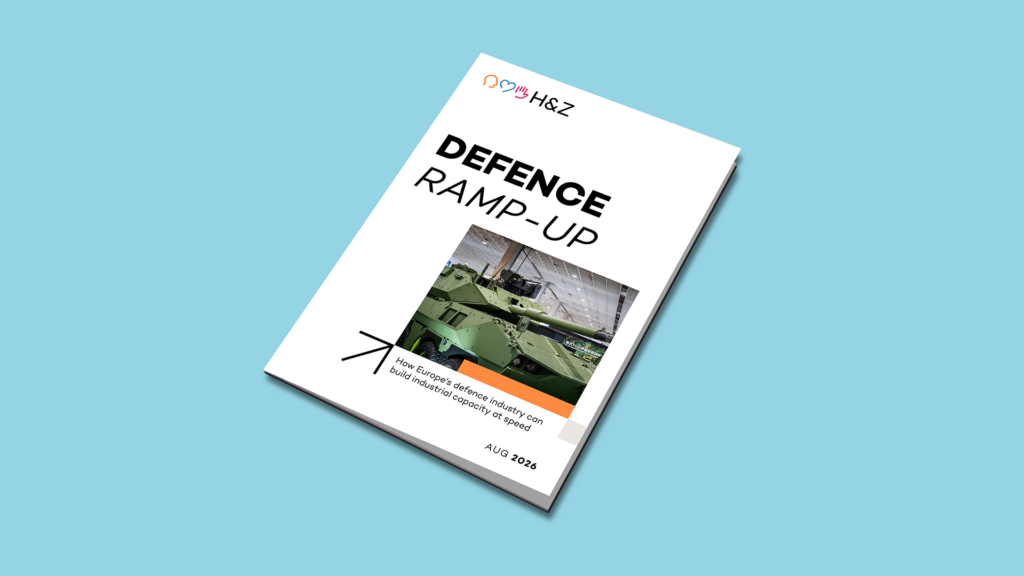
Aerospace & Defence Pulse Check Q2/2026
The defence boom has become a business reality. Our Q2/2026 survey shows how companies are scaling operations and turning rapid growth into lasting profitability.
The H&Z Aerospace & Defence Pulse Check Q2/2026 surveyed 85 industry leaders between 27 May and 3 June 2026, three quarters of them in senior or top management. It records the highest confidence levels since the survey began and shows an industry shifting its focus from growth to industrialisation and operational scale-up.
Strong defence spending is already translating into higher order intake, additional revenue and new customer relationships. The Pulse Check also explores how companies are responding to new market entrants and preparing for the next phase of sustainable growth.
To learn more about how H&Z supports aerospace and defence organisations, explore our industry practice.
THE DEFENCE BOOM IN THREE NUMBERS
READ THE FULL AEROSPACE & DEFENCE PULSE CHECK Q2/2026
Flip through the opening pages to see the sentiment barometer and the key findings. Register once to read the full edition, including the participant profile and the sentiment development over time.
FOUR PRIORITIES FOR THE NEXT PHASE OF GROWTH
The strategic agenda has narrowed. Participants name four priorities, and all four describe the same underlying task: converting a demand surge into an industrial system that holds.
Sustainable and controlled growth
Growth is available. The constraint has moved to the ability to absorb it without losing delivery reliability or margin discipline.
Expanding the defence footprint
Companies with a civil aerospace base are building or enlarging their defence business, which changes qualification requirements, contracting logic, and compliance obligations.
Industrialisation and scaling
Production capacity, workforce, and processes all have to scale together. This is where the sector meets the classic industrialisation questions that automotive answered two decades ago.
Long-term profitability
Order intake is not the same as earnings quality. Securing profitability through the ramp-up is the test the next three years will set.
These four priorities are operational, not strategic redesign. That makes execution speed the differentiator.
NEW ENTRANTS: COMPETITORS OR CAPABILITY?
Automotive Tier 1 and Tier 2 suppliers, and companies from other adjacent industries, are entering the defence market. The industry has looked at this closely and reached a differentiated view.
83%say substantial barriers to entry remain
72%see value in automotive expertise in industrialisation and process excellence
56%do not consider new entrants to be direct competitors
44%believe automotive know-how can help address current ramp-up challenges
The reading is consistent. Aerospace and defence qualification cycles, certification requirements, and programme timelines still protect the incumbent position. What the sector does see in the newcomers is capability it needs: serial production discipline, process design, and scalable operations. Where automotive has spent decades industrialising, aerospace and defence is only now facing the same volumes.
That reframes the question. The relevant decision is not how to keep new entrants out, but which parts of their operating model to adopt.
FROM GROWTH PHASE TO SCALE-UP PHASE
The dominant operational challenge named in this edition is scaling the business itself:
- managing rapid growth without losing control of it,
- ensuring reliable delivery performance under higher volumes,
- expanding production capacity in step with demand, and
- scaling workforce and operational processes accordingly.
None of these is a demand problem. All of them are execution problems, and they arrive together.
This is the structural shift the Q2/2026 edition records. In 2024 the sector expected growth. In 2026 it has to manage it. The companies that come out ahead over the next three years will be the ones that scale faster, industrialise more effectively, and convert growth into sustainable profitability, which puts operational excellence and disciplined procurement and cost management back at the centre of the agenda.
GET IN CONTACT WITH OUR EXPERTS


FREQUENTLY ASKED QUESTIONS
What is the H&Z Aerospace & Defence Pulse Check?
It is a recurring survey of senior leaders in the aerospace and defence industry, run by H&Z. Each edition tracks sentiment, commercial developments, and the operational challenges the sector is working on, so that companies can compare their own position against the market.
How many companies took part in the Q2/2026 edition?
85 industry leaders responded between 27 May and 3 June 2026. Three quarters of them hold senior or top management roles, and 55% are CEOs, managing directors, or owners.
Is the defence boom already showing in company results?
Yes. 78% of participants report an increase in order intake, 67% have already realised additional revenue, and 54% are winning customers outside their traditional customer base. Defence has moved from a future growth opportunity to a visible business driver.
Are automotive suppliers becoming competitors in defence?
Most participants do not see them that way yet. 83% say substantial barriers to entry remain and 56% do not consider new entrants direct competitors. At the same time 72% see automotive expertise in industrialisation and process excellence as valuable to the sector, which makes collaboration the more likely outcome than displacement.
What are the biggest operational challenges in aerospace and defence right now?
Scaling. Participants name managing rapid growth, ensuring reliable delivery performance, expanding production capacity, and scaling workforce and processes as the dominant operational challenges. The strategic priorities follow the same logic: controlled growth, a larger defence footprint, industrialisation, and long-term profitability.