
Optimize Indirect Spend
Maximize profitability by targeting often-ignored Indirect Spend areas, leading to substantial and swift financial improvements.
An organisation’s spend is divided into two categories: direct and indirect. Indirect Spend refers to the procurement of goods, materials, and services not directly related to the production of an organisation’s products or services. This might include logistics, marketing, facilities management, rent, utilities, IT, telecoms, professional services, recruitment, temporary labour, maintenance, or anything that contributes to the organisation’s day-to-day operations. Many finance professionals refer to Indirect Spend as SG&A (Selling, General & Administrative expenses).
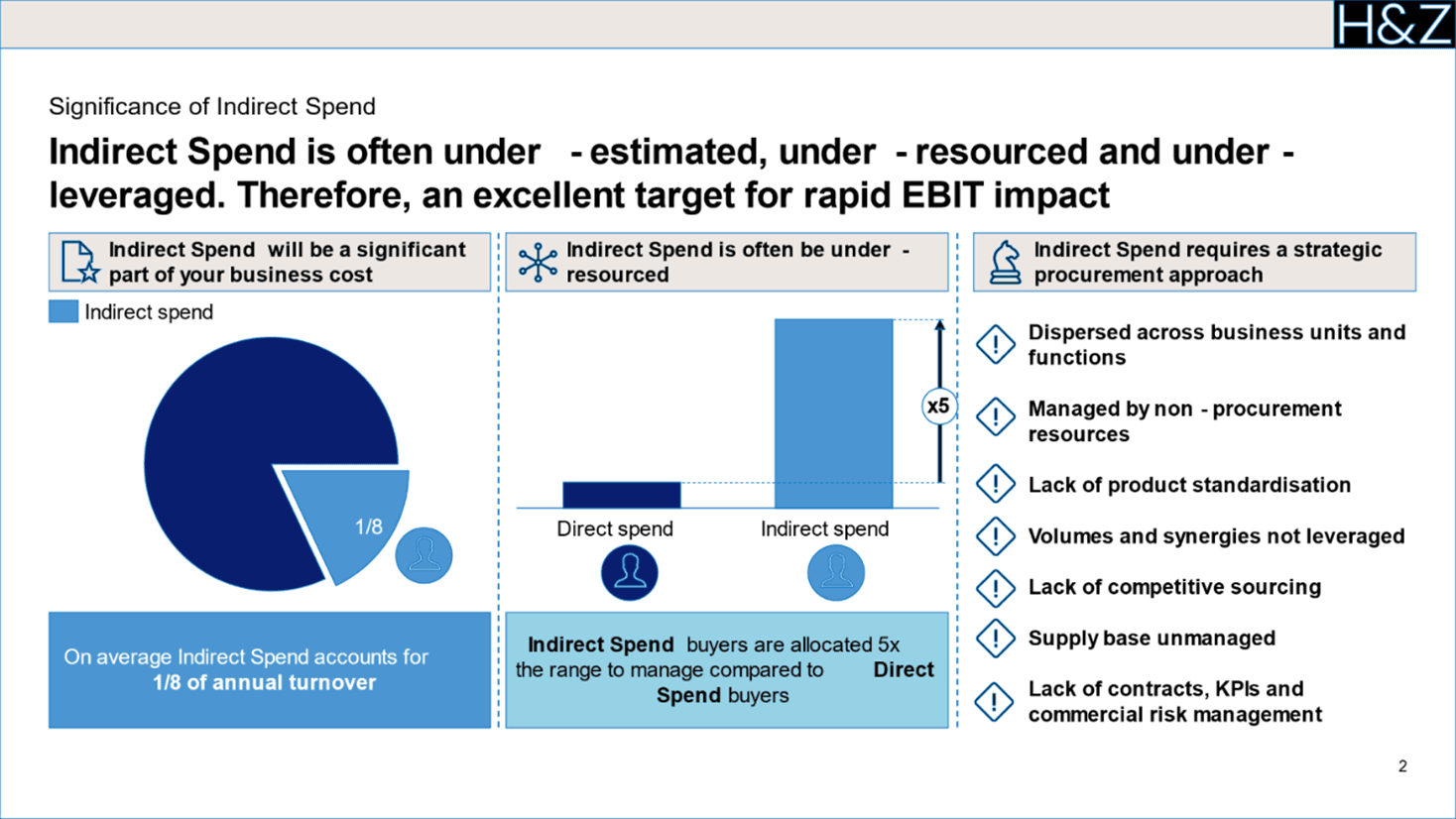
- Indirect Spend often constitutes a significant portion of business costs, accounting for an average of 1/8 of annual turnover
- Indirect Spend is often under-resourced and under-invested. Many organisations do not have any dedicated procurement resource focused on Indirect Spend. If they do, our research shows that Indirect Spend buyers are allocated five times the range to manage compared to Direct Spend buyers
- Indirect Spend is usually under-leveraged, dispersed across numerous suppliers with little economy of scale or product standardisation. This leads to minimal sourcing activity, few contracts, and inadequate commercial oversight, often leaving suppliers unmanaged
Targeting Indirect Spend provides a rapid, readily achievable EBIT impact in less contentious and non-core areas. It is an excellent focus area for quick savings.
Challenges and Opportunities in Indirect Spend Categories
Each indirect category has its own challenges and key issues, which is why organisations often fail to fully leverage potential and optimise spend. Consider marketing, typically a strategic spend, often managed without any professional procurement input. Or temporary labour, where organisations struggle to manage a very high number of agencies, providers, interims, and individuals. Maintenance, repair, and operations (MRO) spend, where reactive requirements and a huge variety of products, services, and suppliers hinder any kind of leverage.
Managing Indirect Spend requires both the capacity to handle diverse tasks and the expertise to conduct thorough analyses.
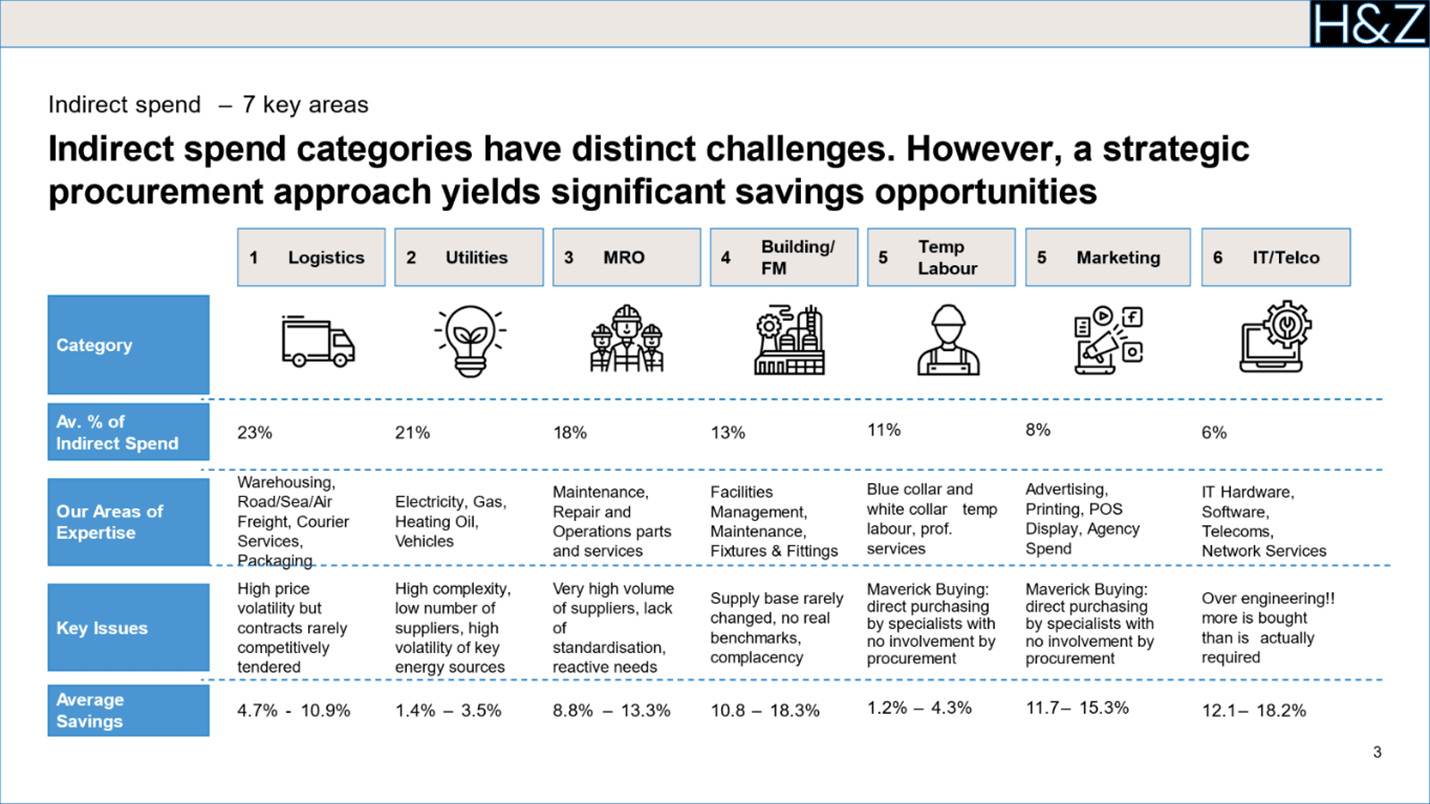
When organisations target Indirect Spend, the savings can be significant. Based on our experience, approximately 60% of the total addressable spend can be tackled in a procurement cost reduction project, with achievable savings ranging from 7.8% to 13.1% across a programme.
For many organisations, using external consulting expertise to deliver savings provides an ideal augmentation strategy, implementing a one-pass step-change impact with an excellent return on investment.
Organisational Strategies for Managing Indirect Spend
Effective management of Indirect Spend necessitates a strategic approach, considering various aspects like strategy, operating model, process, and technology.
Organisations have a range of strategies available to them to address Indirect Spend. These include centralisation versus delegation, direct management versus advisory influence, and investment in own resources versus outsourcing.
The operating model is key. For multi-site, multinational organisations, it is fundamental to structure a way to leverage indirect spend across the entire business. The number of resources and how to focus is a question we often work with Chief Procurement Officers (CPOs) to answer.
Engaging the business is one of the critical success factors in optimising Indirect Spend. Process and technology are some of the most important levers. Businesses now have many options available to use software and technology to support business users in self-service, building specifications and statements of work, access to catalogues, autonomous sourcing, guidance from AI bots, supplier setup, ESG reporting, and intelligent payment mechanisms.
A strategic approach to managing Indirect Spend is essential. We assist organisations in understanding their challenges and developing effective strategies.
Click here to see how our work with a leading healthcare equipment manufacturer helped them set up a global Indirect Spend procurement organisation.
Click here to see how our work with a global marine engine manufacturer transformed their Indirect Spend procurement organisation.
Where to Start?
Conducting a Rapid Procurement Indirect Spend Opportunity Assessment will quickly identify potential savings, pinpoint target areas, and prioritise actions. Deep spend analysis combined with an expert assessment of the current situation by supplier, contract, and category will quickly define the savings on a category-by-category basis combined with strategies to realise potential.