BEYOND FACTOR COSTS
Competitiveness is decided at the drawing board, not the cost sheet. How product, production and value chain architecture give machinery makers a lasting edge.
FACTOR COSTS ARE THE RESULT OF ARCHITECTURAL CHOICES
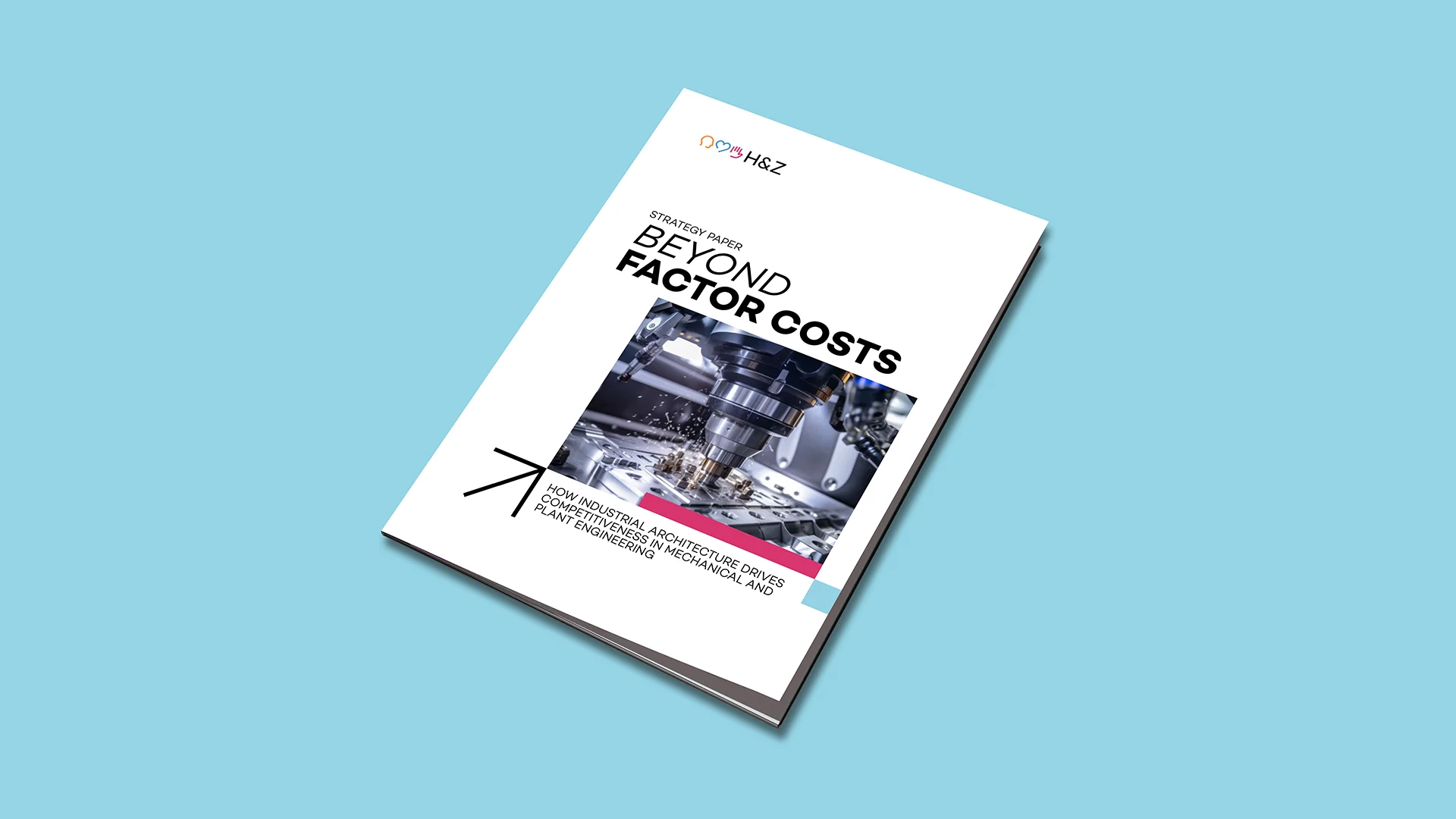
Beyond Factor Costs is a strategy paper by H&Z on the German mechanical and plant engineering sector, published in November 2026. The sector has responded to increasing pressure by reducing factor costs, and moving production abroad. However, factor costs are the result of architectural choices.
While relocation may reduce costs in the short term, it leaves product complexity, manufacturing logic and the value chain largely unchanged. The paper shows how product, production and value chain architecture, designed for scalability, restore competitiveness.
By Sandra Stoll, Rainer Fellenz and Christoph Tertel
GERMANY IS LOSING GROUND
THE FUTURE OF MACHINERY AND PLANT ENGINEERING
The German mechanical and plant engineering sector is approaching a critical juncture. What appeared to be a standard cyclical downturn before has evolved into a fundamental re-evaluation of competitiveness. Intense cost pressures, volatile demand and geopolitical uncertainties require changes in how production is organised.
Until now, the sector has responded to this strain by reducing factor costs. In many cases production has moved abroad. Investment has been held back. Still, its success is under threat and the question remains: how can the mechanical and plant engineering sector remain competitive in Germany?
What we need is nothing less than a paradigm shift. We must look beyond factor costs towards how we build our industrial organisations, towards the scalable architecture underlying products, production and the entire value chain.

“
To regain competitiveness, companies must challenge the underlying industrial architecture and redesign how products are structured, manufactured and where differentiating value is created. This requires a shift from incremental optimisation to fundamental transformation. Those who scale linearly multiply their exposure to variable costs. Those who scale via platforms and modular capacity achieve degressive costs. With its unique depth of engineering and manufacturing expertise, Germany is ideally positioned to lead this transformation.
“

What’s Inside?
- Analysis of the current state of the German mechanical and plant engineering sector including common challenges and market trends
- Four structural shifts that need to be addressed
- Why location decisions are becoming a moving target
- How companies can redesign their industrial architecture from end-to-end
- Scalability through product, production and value chain architecture
- Key questions for C-level management
DOWNLOAD THE STRATEGY PAPER HERE
Ready to outperform your competition? The future of German manufacturing belongs to those who challenge the status quo and reshape their industrial architecture from the core. Download the full paper and find out how to optimise beyond factor costs.
More on our operational excellence work.
CONTACT OUR EXPERTS
Sandra Stoll


YOUR QUESTIONS ANSWERED
What are factor costs?
Factor costs encompass the costs of labour, capital, energy, land, technology and logistics as well as regulation, customs duties, fees, geopolitical risks, capital lock-up and time-to-market.
Why is relocating production not enough?
Factor costs originate in design, not in production. Relocation may reduce costs in the short term, but leaves product complexity, manufacturing logic and the value chain largely unchanged. Factor cost optimisation is external, copyable and a zero-sum game. Architecture optimisation is internal, unique and a positive-sum game.
What is industrial architecture?
Industrial architecture refers to how organisations structure and manufacture their products, and where they create differentiating value. Product architecture defines a product’s components, their interactions and its interfaces. Production architecture defines how product modules and their components are manufactured and assembled. Value chain architecture defines which stages a company performs itself, which it sources externally and where production and supply sit.
How does automation change location decisions?
Automation shifts the weighting of factor costs. Labour costs become largely irrelevant, whilst energy, capital and maintenance expenses dominate. Consequently, automation alters the criteria for optimal site selection.