Industrial Goods Pulse Check H1/2026
Machinery and plant engineering leaders are prioritising margin, cash, and resilience. Our H1/2026 survey shows where execution still falls short.
Machinery and plant engineering companies enter 2026 with a volatile market tailwind. Sentiment is balanced and slowly recovering, but it is not optimistic. In response, leadership teams are prioritising the levers that protect margin and cash: SG&A and overhead efficiency, digitalisation and GenAI, net working capital and cash flow, footprint resilience, portfolio focus, and modularisation.
The H&Z Industrial Goods Pulse Check is a semi-annual survey of senior and top managers at large machinery and plant engineering companies in the DACH region. It tracks how the sector reads its market and where management attention is moving next.
The H1/2026 edition shows a clear execution gap. Companies recognise the right levers, yet only a minority have translated them into scalable operating models. That gap is visible in SG&A steering, footprint maturity, GenAI scale-up, and modularisation adoption.
THE EXECUTION GAP IN THREE NUMBERS
READ THE FULL INDUSTRIAL GOODS PULSE CHECK H1/2026
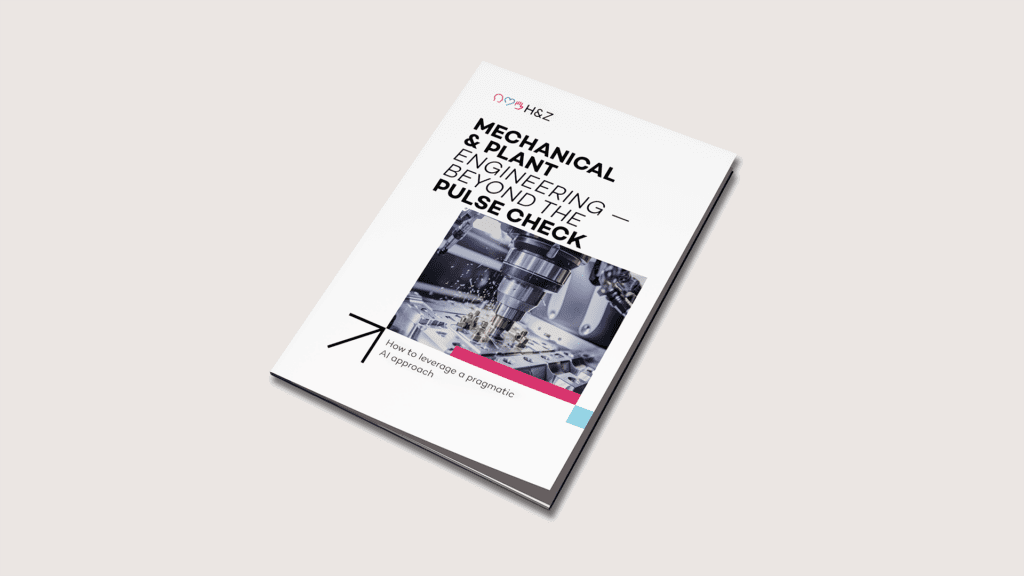
Flip through the opening pages to see the market outlook and the key findings. Register to unlock the full report, including the participant profile, the ranked priority list, and the maturity levels for SG&A, footprint, GenAI, and modularisation.
WHERE MANAGEMENT ATTENTION GOES IN 2026
Industrial Goods leaders are prioritising performance improvement over growth initiatives. Three topics lead the agenda for the next 12 months.
SG&A efficiency
Overhead moves from a support-cost topic to a competitiveness lever. Complex portfolios, engineering-heavy organisations, and decentralised structures create layers that traditional cost-cutting does not reach.
Digitalisation and GenAI
GenAI has passed the productive use case threshold. Value now depends on scaling what works rather than adding pilots, with procurement offering one of the fastest paths to measurable impact.
NWC and cash flow optimisation
Liquidity discipline stays on the board agenda. With demand visibility limited and tariffs shifting, cash generation is treated as a performance lever, not a finance exercise.
These priorities require operational execution, not strategic redesign. That makes implementation speed the real differentiator in 2026.
RECOGNISING A LEVER IS NOT THE SAME AS SCALING IT
The pattern repeats across every topic in this edition. The lever is understood, the business case is accepted, and implementation stops at the pilot or the analysis.
- SG&A: most companies report historically grown overhead with limited steering, while only a minority work with clear target ratios and active benchmarking.
- GenAI: nearly half already generate measurable value from selected use cases, but very few have scaled GenAI across core processes. Procurement and cost management is where we see the shortest route from use case to measurable impact.
- Footprint: more than half of companies still lack the footprint flexibility needed to manage tariffs, factor cost shifts, and geopolitical uncertainty.
- Modularisation: widely recognised as a strategic lever, yet implemented selectively and rarely used to guide sourcing, footprint, and service decisions.
Competitive advantage in 2026 will come from connecting product architecture, footprint decisions, procurement, SG&A steering, and AI deployment in one shared performance agenda. In practice that is an operational excellence question before it is a technology question.
GET IN CONTACT WITH OUR EXPERTS
Sandra Stoll
With over 25 years of experience, Sandra leads H&Z’s Industrial Goods industry driving measurable performance improvement in engineering-driven manufacturing organisations.

Christoph Tertel
Christoph focuses on performance and cost optimisation in the industrial goods sector, known for determination and focus in delivering strategic, hands-on solutions.


FREQUENTLY ASKED QUESTIONS
What is the H&Z Industrial Goods Pulse Check
The Industrial Goods Pulse Check is a semi-annual H&Z survey of senior and top managers at large machinery and plant engineering companies in the DACH region. It captures how the sector reads its market outlook and which levers leadership teams prioritise for the coming 12 months.
What is the market outlook for machinery and plant engineering in 2026
Sentiment has improved compared with previous editions but remains cautious. Positive and negative expectations are close to balanced, and geopolitical tensions, tariff uncertainty, and supply chain shifts continue to limit planning visibility. Companies cannot rely on market recovery alone to drive performance.
Why is SG&A a competitiveness topic in Industrial Goods
Because 72% of participants report inefficient or historically grown overhead structures, while only 28% operate with competitive SG&A maturity. Engineering-heavy organisations and decentralised structures build up layers that traditional cost-cutting does not reach, which makes overhead one of the largest untapped improvement opportunities in the sector.
How far has GenAI adoption progressed in Industrial Goods
GenAI has moved beyond experimentation, with nearly half of respondents already generating measurable value from selected use cases. The bottleneck is scaling: only 8% have scaled GenAI across core business processes. Procurement offers one of the fastest paths to measurable impact, for example in material costs and supplier risk management.
What should Industrial Goods companies prioritise in 2026
The greatest impact comes from one holistic performance programme rather than separate initiatives. Companies that connect SG&A efficiency, cash optimisation, footprint decisions, modularisation, and AI deployment into a single agenda turn recognised levers into measurable margin, cash, and resilience gains.